
From Battery to Retirement: Energy Storage Recycling and the Rise of a Circular Economy
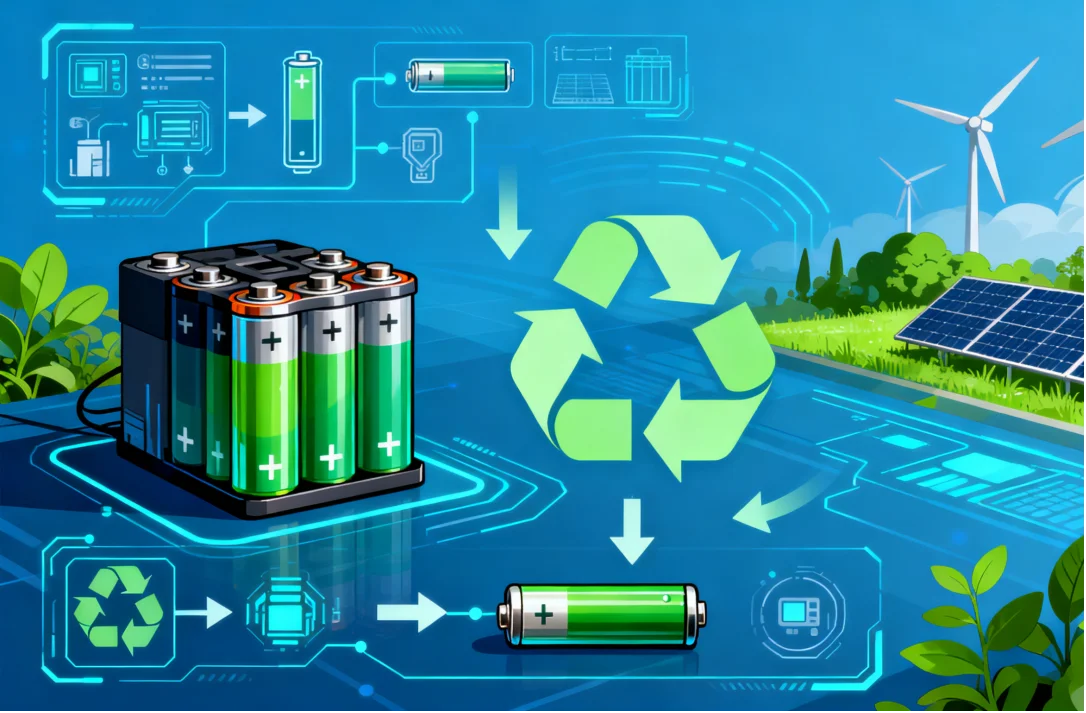
In the new energy industry, we often talk about “production” and “usage,” but there’s one step that’s easily overlooked — “recycling.” As energy storage batteries are being deployed on a large scale, a new topic is emerging: from battery use to retirement and then to regeneration, recycling has become a vital part of the circular economy.
In recent years, energy storage systems have expanded rapidly around the world. Whether in commercial and industrial projects, grid peak shaving, or home energy storage, installation capacity keeps soaring. But have we really thought about what happens after five or ten years? These batteries won’t last forever. When they retire, improper disposal can lead to both resource waste and environmental pollution.
In fact, the reuse of retired energy storage batteries has already started to form a new industrial chain. Some battery cells, although no longer suitable for high-demand applications, can still be reconfigured and reused in low-power scenarios — such as telecom base stations, backup power systems, or distributed storage. This not only reduces waste but also extends the lifespan of the batteries, unlocking more economic value.
The deeper value lies in “recycling and remanufacturing.” Retired batteries contain valuable metals such as lithium, nickel, and cobalt. If these materials can be efficiently extracted, they can reenter the production cycle. Many companies in China, Japan, and Europe are investing heavily in this area, using techniques like hydrometallurgy and pyrometallurgy to recover metals. Though the process seems complex, it represents a more sustainable energy logic — a closed-loop resource system.
However, while the idea sounds great, it’s not that easy to execute. The biggest challenges for energy storage recycling are standardization and economics. Different manufacturers use different chemistries and structures, which makes disassembly and testing costly. And since the recycling network is still developing, many companies find it difficult to make a clear profit. In short, the environmental value is clear, but the financial returns are not always so obvious — at least for now.
Still, progress is being made. With government policies promoting traceability, battery coding, and standards for secondary use, the recycling ecosystem is slowly taking shape. In the future, when every single cell can be digitally tracked — from production to operation, to retirement, and then recycling — the true value of the circular economy will finally shine through.
Companies like Huijue Technology, which focus deeply on energy storage, are also paying close attention to this process. Beyond improving product safety and lifespan, they’re exploring the concept of “full lifecycle management.” From the design stage, they consider future recyclability — using modular structures, standardized interfaces, and traceable data systems — making second-life and recycling much easier. This is the real embodiment of circular thinking in the energy storage industry.
Another interesting perspective is the “EV battery retirement.” With the rise of electric vehicles, large numbers of EV batteries are reaching their end of life, but many of them can still be reused in energy storage applications — what we call the “EV-to-storage” model. Compared with new batteries, retired EV cells are cheaper and still perform well enough for industrial or residential storage. It’s a win-win for both cost savings and sustainability.
Some people may worry about safety. In reality, as long as retired batteries go through proper testing and classification, most cells can operate safely. In fact, there are already successful projects — for example, in Europe, old EV batteries are being repurposed into community storage systems that supply electricity to homes. It’s not just a concept anymore; it’s happening.
Overall, from battery use to retirement and regeneration, energy storage recycling is not just an environmental issue — it’s an industrial opportunity. In the future, whoever builds a complete recycling system will lead the circular economy wave. The development of energy storage shouldn’t only be about capacity expansion; it should also be about green circularity — making every kilowatt-hour and every cell go further, and last longer.
Maybe that’s what the real “future of energy storage” looks like.

Contact US