
What Is an On Grid Solar System and Off Grid Solar System?
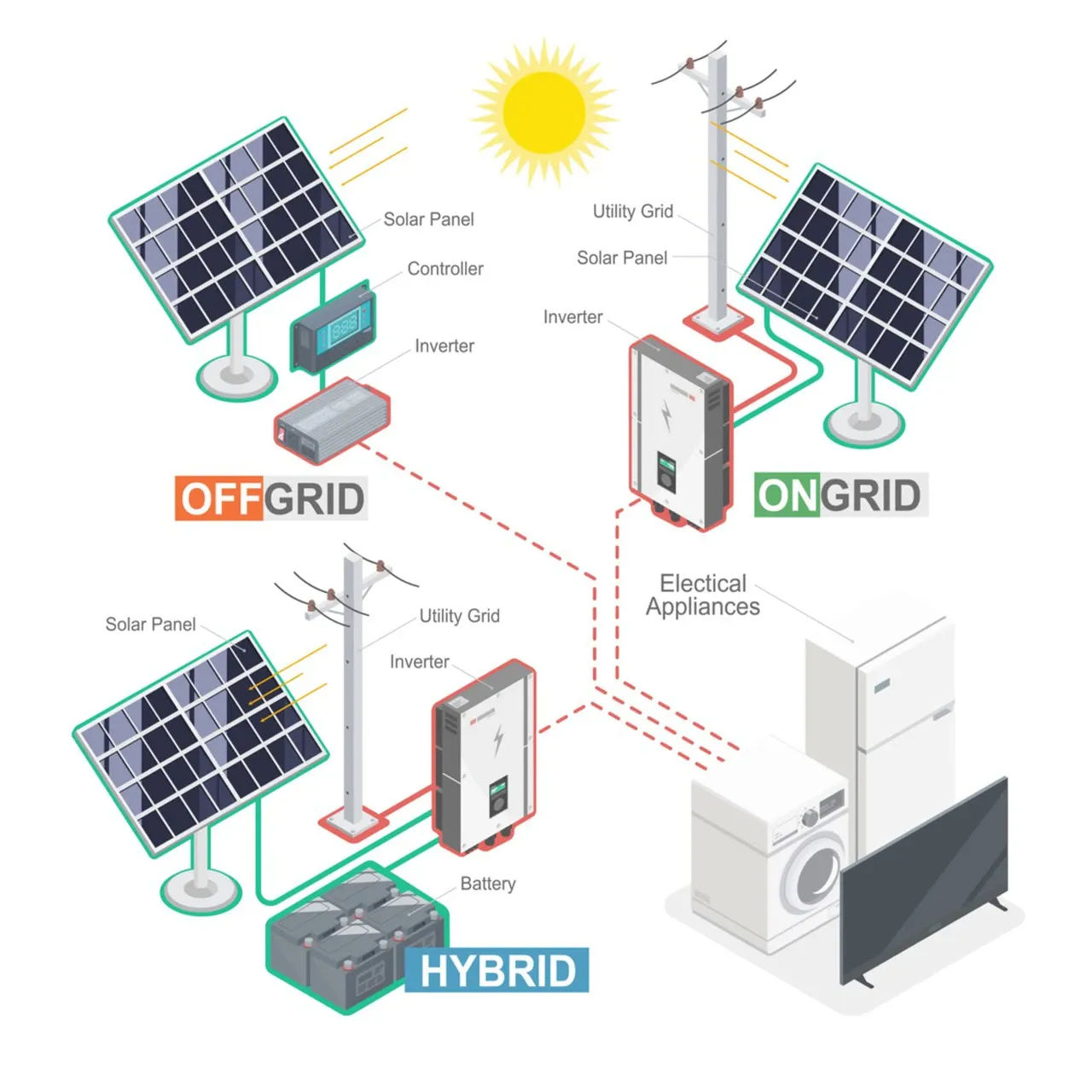
An on grid solar system and an off grid solar system are similar in the sense that they are able to harness solar power. However, the fact that the on grid solar system can be connected to the public grid while the off grid solar system does not require connection to the public grid at all means that there are fundamental differences. When comparing these two solar systems, the question is not just what they are, but rather how they operate in relation to the public grid.
In essence, an on grid solar system is connected directly to the public grid, while an off grid solar system does not require the public grid at all.
What Is an On Grid Solar System?
An on grid solar system, also known as a grid-tied solar system, is a solar system that can operate in conjunction with the public grid. It operates on the basis where the solar panels are able to harness solar power, which is then converted into DC current. This current is then used in the household.
The U.S. Department of Energy’s publication Grid-Connected Renewable Energy Systems explains that grid-connected systems allow homeowners to use renewable energy while remaining connected to utility power, providing continuous electricity without the need for large battery storage.
How Energy Flows in a Grid-Tied System
In a normal on-grid system, the following happens:
- The solar panels generate energy during the day.
- The inverter ensures that the energy is in sync with the grid.
- The energy generated by the solar panels is used in the home.
- Any additional energy is fed back to the grid.
- During the night or on cloudy days, energy is drawn from the grid.
This is an efficient system because the grid acts as a battery to store energy virtually. It does not require storing energy in a battery because the grid will handle it.
Advantages of On Grid Systems
Grid systems are often the most cost-effective solution for residential consumers, since:
- There is no need for a battery bank.
- Installation is simpler.
- Maintenance is reduced.
- Return on investment can be more rapid in areas where net metering is allowed.
However, there is a major disadvantage: in the event of a grid failure, most grid-tied systems will turn off, as this is a safety precaution. This means there is no “backup” available, unless additional equipment is installed.
What Is an Off Grid Solar System?
An off grid solar system is a completely independent system from the public grid. It is self-contained, providing and using its own electricity. It has no “backup” from any public utility.
This is often used in areas where there is no public grid, or where the cost of grid extension is prohibitive. It is also used by those who want to be “off the grid” and independent from public utilities.
Core Components of an Off Grid Solar System
A basic off grid system will have the following:
- Solar panels
- Charge controller
- Battery bank
- Off grid inverter
- Backup generator (often required)
A battery bank will be required. Without the ability to feed in to the mains, there will be no place for the excess energy to go. Careful consideration will be required for the amount of energy used at night or during periods of low sunlight.
Why Storage Is Critical
When designing an on grid system, there will be a place for the excess energy to go. In an off grid system, there will be no place for the excess energy to go except into the battery bank.
Undersized batteries cause outages. Oversized batteries require higher up front costs.
On Grid Solar System vs Off Grid Solar System: Key Differences
Understanding the structural differences makes comparison easier.
| Feature | On Grid Solar System | Off Grid Solar System |
| Grid Connection | Connected to utility grid | No grid connection |
| Battery Requirement | Optional | Mandatory |
| Backup During Outage | No (unless hybrid) | Yes (if batteries charged) |
| Initial Cost | Lower | Higher |
| Energy Independence | Partial | Full |
| Complexity | Moderate | High |
The on grid solar system focuses on efficiency and cost savings, while the off grid solar system focuses on autonomy and self-reliance.
Which Solar System Is Right for You?
To choose between the two, you will need to consider the following:
Location
If you are living in an urban or suburban area, the on grid solar system will be the most appropriate choice, but if you are living in a remote area, the off grid solar system will be the only alternative.
Budget
On grid systems, in general, require less investment because they do not require battery storage on a large scale. Off grid systems require battery storage, which makes them more expensive.
Energy Goals
If you want to save on your energy bills and want to be more sustainable, grid-tie systems are the best option. However, if you want to be independent of energy providers, off grid is the clear choice.
Reliability Expectations
Some people think that off grid automatically makes them more reliable. However, this is not the case because off grid requires correct sizing of the system to work effectively. In fact, a bad off grid design will fail in cloudy weather. On the other hand, a grid-tie system gets its power from a central source.
Hybrid Systems: A Middle Ground
There is also a third option: hybrid systems. These use a combination of grid-tie and battery backup systems. They function as on grid systems, with battery backup in the case of outages.
The hybrid systems solve one of the biggest drawbacks of standard grid-tie systems: the fact that they do not provide backup in the case of an outage. However, this comes at the cost of increased complexity.
Long-Term Considerations
The first thing to note is that the price of the technology will continue to drop as time goes on. In fact, the price of batteries has gone down significantly in the past decade or so, making off grid and hybrid systems more viable options than ever before. However, this does not change the fact that the biggest variable in terms of cost will remain battery storage.
Another thing to note is that there is the issue of maintenance as well. While battery storage will require some level of maintenance and will eventually have to be replaced, grid-tie systems do not require as much supervision.
Final Thoughts
While an on grid system provides simplicity, cost efficiency, and integration with the grid system, an off grid system provides independence, autonomy, and complete control over your energy resources.
If your place already has access to reliable grid resources and your main objective is to save money on your electrical bills, then an on grid system would be the best place to start. But if your main desire is to have complete independence in your energy resources or your place is not connected to the grid system, then an off grid system would be a strategic investment for your energy resources.
But before you make your choice, you need to assess your energy consumption needs, your local energy resources, and your access to sunlight. A properly sized system will be much more important to your energy needs than whether it is an on grid or off grid system.
Contact US